At Orchard & Hive, science often inspires our art. Now, you can bring science-inspired art projects to your children or students with our STEAM activities. In this STEAM activity, children will be exploring the world of watercolor. We’ve matched up a favorite spring experiment with a floral watercolor art activity. So put on your paint smocks and join us as we make the world a little more colorful!
The Science: Color Changing Flowers Experiment
Materials:
Directions:
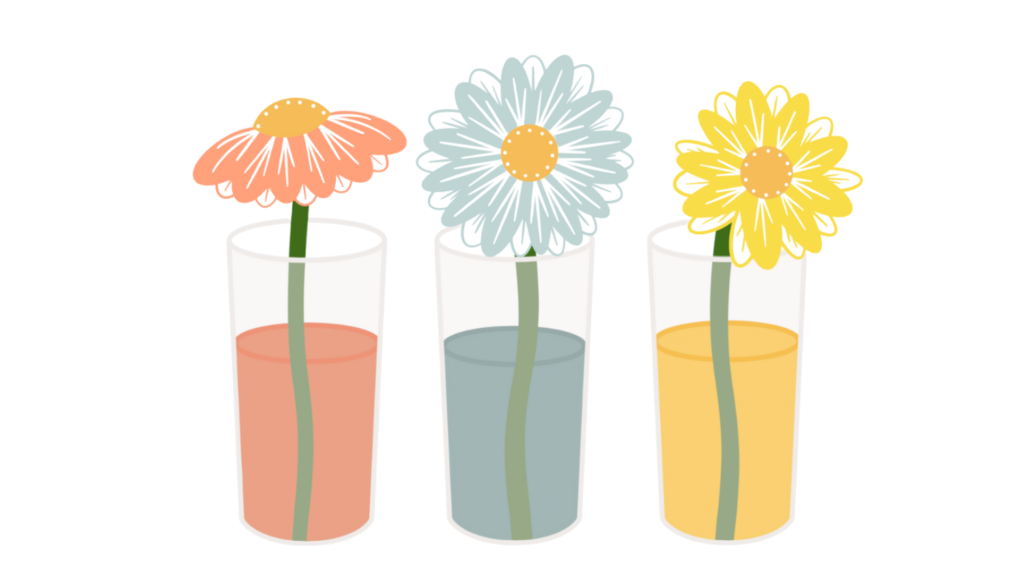
- Fill each glass about ½ full of water. Add food coloring, one color per glass.
- Cut your flower stems to fit your jar or glass. Trim the ends of your flower stems diagonally at a 45-degree angle, to help the flowers absorb more water. Place them in the glasses.
- Watch and wait as the flowers soak up the colors. This step may take a few hours or a few days, depending on how much food coloring you added.
Flowers absorb water through their roots and stem. The food coloring is transported with the water through the stems and into the petals, tinting them with color.
Tip:
If the flowers don’t seem to be absorbing much water, try trimming the stems again. You can also add more food coloring to see more color saturation in the petals.
The Art: Floral Watercolor Painting
Now that you’re inspired to use water to create colorful blossoms, experiment with watercolor paints to create a floral design. You can even use this art activity as a record sheet. Have children show the end results of their experiment by painting their newly colored flowers!
Materials:
Directions:
- Dip the paintbrush into the water. Add color using the watercolor paints.
- Instruct children to paint five large dots in a circle to create flower petals.
- Rinse out the paintbrush, then add a new color using the paints. Paint another dot in the middle of the circle to connect the petals.
- Rinse and repeat, adding green paint to the paintbrush. Next, add a line for your stem. Add leaves, if desired.
- Continue to fill the page with flowers. Have children notice the way the water and colors blend together in some spaces to create the signature watercolor look.
Tip:
If your students are a pro at watercolors, skip the instruction and let them experiment with their floral design. Encourage children to use a variety of colors to create vibrant, colorful petals.